
Why homeowners are managing their biggest investment without a real system.
operating system
Get the full report as a PDF.
See the data, checklist, and proactive homeowner framework in a shareable PDF you can keep.
Homeowners aren't ignoring their homes. They're managing too much without a system.
A clear pattern emerged in the survey: most homeowners rely on memory, phone reminders, warranty companies, spreadsheets, paper lists, or simply waiting until something feels urgent.
They're not lazy or careless. They're trying to manage too many moving parts without one clear place to see what's due, what's covered, what's been done, and what needs attention.
The Home Readiness Gap
The difference between owning a home and feeling prepared to manage it.
Buying a home is one of the biggest financial milestones in a person's life. But after closing day, many homeowners are left to figure out the operational side of homeownership on their own.
They receive keys, appliance manuals, warranty documents, inspection notes, contractor names, receipts, emails, text threads, and advice from family, friends, builders, realtors, and the internet. What they rarely receive is a simple system that answers: What needs attention this month? What's still under warranty? What's already been done? Is my home actually in good shape?
Home readiness isn't about being perfect. It's about visibility — knowing what needs attention, what's covered, and what to do next.
The cost of homeownership isn't just the mortgage. It's what happens after move-in.
Homeownership is getting harder to enter — and harder to manage once you're in.
First-time buyers now make up a record-low share of the market, and the median age of first-time buyers has risen to 40 — many people are waiting longer, spending more, and entering with more financial pressure than previous generations. Once the keys change hands, homeowners inherit a second job: maintaining the systems that keep the home safe, functional, and protected. And when those things aren't tracked, small issues become expensive surprises.
The risk is not the average. The risk is the surprise.
Average annual numbers may look manageable. But one missed issue, one expired warranty, one overlooked leak, or one repair no one planned for can cost several times more than expected. That's why proactive homeownership matters.
Every home already has an operating system. Most homeowners just can't see it.
A home is a collection of systems. Each one has its own timeline. Each one can be forgotten. Each one can become expensive. And each one affects how ready, safe, and protected the home feels.
Yet most homeowners still manage these moving parts through memory, paper folders, phone reminders, screenshots, warranty portals, spreadsheets, emails, and "I'll deal with it later."
That may work for a while — until something breaks.
Tracking is not the same as having a system.
Some homeowners aren't starting from zero. They already have reminders, spreadsheets, folders, text threads, email receipts, warranty portals, and contractor notes. But scattered tracking can still leave the homeowner without true visibility.
- The record
- The reminder
- The warranty
- The cost
- The next action
Fragments are easy to lose. They're hard to connect. And when a repair becomes urgent, the homeowner is still left searching.
A real home system should connect the record, the reminder, the warranty, the cost, and the next action.
The Reactive Homeowner Trap
Reactive homeownership usually doesn't start with neglect. It starts with life.
You get busy. You forget the filter. You misplace the receipt. You assume the warranty is still active. You notice a small leak but wait to see if it gets worse. You search old texts for the contractor's name. You realize too late that the claim window passed.
That's the reactive homeowner trap: when the home only gets attention after it creates stress.
The Warranty Blind Spot
Warranties should give homeowners peace of mind — but only if they know what's covered, where the documents are, when coverage expires, and how to make a claim before the window closes. In the survey, warranty confidence was one of the clearest gaps.
A warranty can exist on paper but fail in real life. If a homeowner can't find the receipt, remember the claim window, locate the serial number, or prove coverage quickly, the warranty becomes less useful exactly when they need it most. The problem isn't the warranty. It's the system around the warranty.
A warranty that can't be found, remembered, or used in time isn't really protecting the homeowner.
The cost of "I'll remember later."
The most expensive home problems aren't always dramatic at first. Sometimes they begin as ordinary missed maintenance: a clogged HVAC filter, a neglected drain line, a forgotten appliance registration, a missing receipt, a small leak, an overdue inspection, or a system that was never added to a schedule.
The U.S. Department of Energy notes that neglected air-conditioner maintenance can reduce performance and increase energy use. ENERGY STAR advises changing filters regularly and warns that a dirty filter can damage equipment and lead to early failure.
The issue isn't that homeowners don't care. It's that the home has no memory unless the homeowner creates one.
Without a home record, every decision is harder: What happened last time? Who fixed it? What did it cost? Was it under warranty? Is this a repeat issue — or urgent?
What proactive homeowners do differently.
Proactive homeowners don't wait for the home to surprise them. They create visibility — and that changes the questions they're asking.
- Waits for the home to surprise them
- Searches old texts and emails for receipts
- Assumes coverage is still active
- Reacts once it's already stressful
- Knows what needs attention
- Tracks what's been completed
- Understands what's covered
- Has a plan before it's urgent
Proactive homeownership isn't about perfection. It's about readiness.
Even a working system can miss patterns.
Some homeowners already have a process that works for them. They save receipts, use spreadsheets, set reminders, and keep folders organized. That's a great start. But even organized homeowners can miss the bigger picture.
A strong home system shouldn't only store information. It should reveal patterns: repeat repairs, rising costs, expiring warranties, seasonal maintenance gaps, and documentation that could matter during resale, insurance claims, or future renovations.
It's "Can I see what it means?" The next standard isn't just organized records — it's useful visibility, the kind that turns a tidy folder into early warnings and resale-ready proof.
Your home should not run on memory.
Eelay is built around a simple belief: homeowners deserve a clearer way to manage the place they worked so hard to own.
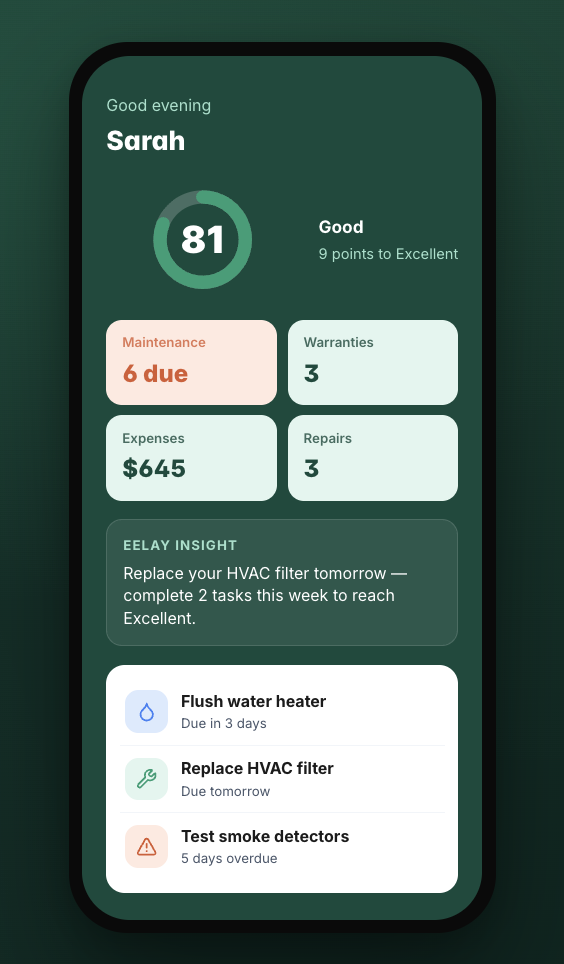
Eelay is the home maintenance operating system made for proactive homeowners. It brings maintenance, warranties, documents, expenses, repair history, and overall home health into one place. The goal isn't to make homeownership feel more complicated — it's to make it feel clearer.
When homeowners can see what's due, what's covered, what's been done, and what needs attention, they make better decisions with less stress.
Eelay helps homeowners move from reactive homeownership to proactive homeownership.
What is the Eelay Home Score?
Every homeowner has wondered some version of one question: "Is my home actually in good shape?" The Eelay Home Score helps answer it — a simple signal for the home's overall readiness and health.
Instead of guessing, homeowners can understand how their home is doing based on:
- Maintenance activity and overdue tasks
- Warranty visibility and document organization
- Repair history and possible risk areas
It's knowing what the number means — what's going well, what needs attention, and what small action improves your readiness next. Not a replacement for a home inspection; a practical signal you can act on.
Homeowners are asking for clarity, not complexity.
Asked what features matter most, homeowners pointed to practical tools that reduce stress, prevent surprises, and make home management easier to follow. They want to know what to do, when to do it, what might be covered, who to call, what it costs, and how their home is doing.
The first 90 days after move-in matter.
First-time homeowners are often prepared for the purchase. They're less often prepared for the operation. The first 90 days are when homeowners should build their home record — before receipts, warranties, contractor names, inspection notes, and maintenance tasks get scattered.
That doesn't mean doing everything at once. It means creating a source of truth early, while the information is still fresh and easy to find. A home comes with keys. It doesn't always come with a manual.
- Save appliance manuals and receipts
- Log warranty dates and claim details
- Add recurring maintenance tasks
- Create contractor categories
- Store inspection notes and closing documents
- Track first repairs and service visits
The First-Time Homeowner Warning List.
Before buying, most people think about the mortgage, down payment, insurance, taxes, and closing costs. After buying, they quickly discover a different set of questions.
- How often should I change the HVAC filter?
- Where do I store appliance receipts?
- What maintenance does a water heater need?
- How do I know if the builder warranty still applies?
- Who do I call for plumbing, electrical, HVAC, pest, roofing, or drainage?
- How do I know if a repair is urgent?
- How much should I budget for maintenance?
- What records should I keep for resale value?
- What maintenance is due this month?
- Is my home becoming healthier or riskier over time?
These questions aren't glamorous. But they're the ones that protect the home.
The Proactive Homeowner Checklist.
A proactive homeowner should be able to answer these ten questions quickly.
- What maintenance is due this month?
- What maintenance is overdue?
- Which appliances are still under warranty?
- Where are the receipts, manuals, and warranty documents?
- Who are the trusted contractors for each major system?
- What repairs have been completed in the last 12 months?
- How much has been spent on maintenance and repairs this year?
- What issues have repeated more than once?
- What seasonal tasks should be scheduled before they're urgent?
- What is the overall health of the home today?
If you can't answer most of these quickly, you're not alone. That's the Home Readiness Gap — and closing it starts with creating a system.
Is your home running on memory?
A quick gut check. If you can't answer most of these in under five minutes, your home may need a clearer system.
- Do you know what maintenance is due this month?
- Can you find your appliance warranties in under five minutes?
- Do you know what you spent on repairs this year?
- Do you know which issue has repeated more than once?
- Do you have one place for records, receipts, warranties, and contractors?
Your home shouldn't require a scavenger hunt every time something needs attention.
The future of homeownership isn't just smart devices. It's smarter ownership.
A smarter home isn't only a home with connected lights, cameras, thermostats, and locks. It's a home with a record, a rhythm, and a plan.
That's the new standard proactive homeowners deserve. Homeowners shouldn't have to wonder what's due, what's covered, what's missing, or what to do next.
They should be able to see it.
A home maintenance operating system for proactive homeowners.
Eelay brings maintenance, warranties, documents, expenses, repairs, and overall home health into one place — so homeowners can stop relying on memory and start managing their home with clarity.
Track upcoming maintenance, store important documents, keep up with warranties and receipts, monitor repair history and expenses, understand your Home Score, and see what needs attention before it becomes a costly surprise. Eelay is built for homeowners who want to protect their investment, reduce stress, and feel more confident managing the place they worked so hard to own.
Your home should not run on memory.
Get your Home Score and see what your home needs next — in minutes, in one place.
Get your Home Score →How to read this report.
The Home Readiness Report 2026 is based on findings from the Eelay Homeowner Readiness Survey 2026, an early market-research study designed to better understand how homeowners manage maintenance, warranties, repair history, expenses, and home-related documents. The findings are directional, meant to highlight common behaviors, pain points, and opportunities in modern homeownership. Additional context was drawn from publicly available housing, maintenance, repair-cost, energy, and insurance research.
How healthy is your home, really?
Get your Eelay Home Score and see where your home stands today — what's due, what's covered, and what to do next.
Get your Home Score →Based on findings from the Eelay Homeowner Readiness Survey 2026. Findings are directional and based on early market research. © 2026 Eelay · geteelay.com